
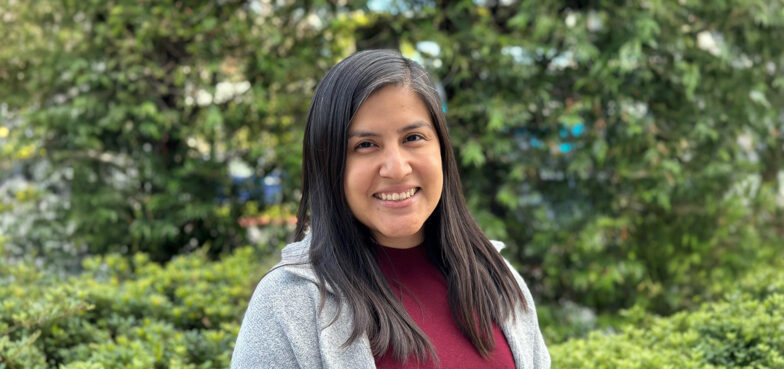
Share a little bit about yourself: Your background, family, where you grew up, and what Class you were in?
My name is Sonya Vargas Lima — Vargas from my dad’s side and Lima from my mom’s. My parents immigrated to the United States from Mexico and met in San Diego, where I was born and raised alongside my older brother. When I was about 10, my family moved to City Heights, where I attended Wilson Middle School and Hoover High School, graduating with the Class of 2009. I later became a Gaucho at the University of California, Santa Barbara, earning a Bachelor of Science in Zoology.
After graduating, I completed several internships, including one with the Bureau of Land Management in Redding, California. I went on to work in my first full-time role as a Marketing Administrative Assistant and Biologist at RECON Environmental, where I gained valuable experience in environmental consulting and eventually transitioned into a restoration biologist role. I later joined Environmental Science Associates, where I now serve as a Senior Biologist and continue to learn and grow every day.
How has the Cardinals Interact Program impacted you?
The Cardinals Interact Program provided me with a safe space to be myself, try new experiences, and build meaningful connections with my peers. Through job shadow days, I gained some of my first exposure to professional settings and learned how to navigate those environments with confidence. I also received encouragement and support from advisors to apply for scholarships and financial aid, and to navigate the college application process.
After graduating from college, I remained connected to the program as part of a cohort of Cardinals Interact alumni who helped charter the City Heights Rotaract Club. Over the years, I took on various leadership roles and eventually served as Club President during the 2018–2019 Rotary year. These experiences helped strengthen my leadership skills, build confidence, and open the door to many new opportunities.
Did the Cardinals program influence the career path you chose? If so, in what ways?
I believe the Cardinals Interact program influenced my career path by giving me opportunities to explore different professions through job shadowing, which helped clarify my interests. After entering the field of environmental consulting, the interpersonal, communication, and professional skills I developed through Cardinals Interact and Rotaract continued to support my growth and helped me achieve my goals.
What other factors and experiences in your life contributed to your interest in this field?
I always loved nature and the outdoors, but I never really knew about environmental consulting, let alone considered it as a career path. One of the other programs I was involved with, Ocean Discovery Institute, allowed me the opportunity to help plan a large community-based restoration event in our urban canyon. I didn’t know it at the time, but that experience was my first exposure to the environmental consulting field, since there were environmental consultants, landscape architects, and so many others who helped make that event possible. After college, I was offered a summer internship at RECON Environmental, a consulting company Ocean Discovery had partnered with, and that helped support the restoration event. That internship eventually led to my first full-time job.
How long have you been working in your field?
I have been working in this field for over nine years, and I conduct a variety of biological surveys, prepare technical reports, contribute to restoration projects, supervise junior staff, and manage a range of project types.
What accomplishments are you most proud of in your work? Or in life in general.
I am proud to be a first-generation college graduate and of the mentorship, management, and leadership roles I have taken on over the years. Most recently, I became a Board Member of the California Society for Ecological Restoration and will serve as a Co-Chair for an upcoming conference in Redlands. In this role, I am helping support the next generation of professionals by expanding access to a space where participants can learn about restoration, build their networks, and consider careers in restoration ecology.
I consider myself introverted and shy, so stepping into leadership roles and unfamiliar spaces can be challenging at times. What helps is knowing that I am contributing to goals and missions that matter deeply to me. I also remind myself that I am not alone and that I am fortunate to have a strong support system willing to help me work through challenges, doubts, and new ideas.
What do you feel are the greatest challenges and rewards in your field?
Some of the greatest challenges in my field include prioritizing workloads and keeping track of important details during fieldwork, especially when managing multiple projects with different timelines and deadlines. At the same time, some of the greatest rewards come from experiencing beautiful field sites, many of which are not accessible to the public. Our phones are often filled with site photos, field selfies, unfamiliar plants we need to identify later, and memorable bird and wildlife sightings captured along the way.
Can you share something about your life outside work, such as hobbies, traveling, etc.?
My hobbies are centered around art and music, but I don’t feel very good at either! I sometimes find it challenging to focus on a single project or learn an entire song, but I enjoy dabbling in guitar and, more recently, the ukulele. I also like sketching, painting with different mediums, creating digital art, and have recently started experimenting with felt and wool figure-making.
Finally, based on your life experiences, what advice would you offer to the youth served through Price Philanthropies programs and City Heights partners?
Always take advantage of new opportunities because you never know where they may lead. Try not to pass on an opportunity simply because you feel unqualified or worry that you won’t fit in. One of the greatest challenges across any industry is accepting that we will never have all the answers or feel fully prepared for everything asked of us.
We are all works in progress. While we can build confidence through learning and experience, new situations will inevitably arise that make us feel uncertain again. The way we handle those obstacles demonstrates our capabilities and work ethic, so remember that it is okay to ask for help or advice.